

Hertford Puts the Clock Back: Subverting the Universities Tests Act 1871
Institutions tend to fashion their historical narratives to suit present ambitions rather than past facts. Today, Hertford College, Oxford, projects an image of progressive openness and liberality as its immutable identity. Yet its foundation reveals a creation of very different stamp. The Hertford College, Oxford Act of August 1874 (37&38 Vict. C. 55) concealed a deliberate and successful attempt to reverse the central principle of the 1871 Universities Tests Act which had abolished religious restrictions to membership of the university. The incentive for this constitutional sleight of hand was money. The new college, an incorporation of an existing private hall, Magdalen Hall, required endowment. And endowment demanded donors. Hertford's was the newly elected Conservative MP for South Essex and former fellow of Brasenose, T.C. "Charley" Baring. A member of the prominent banking family, Baring was a diehard, irascible reactionary. He had already drafted a private member's bill allowing college endowments to be restricted by religious tests, in direct contravention of the 1871 Act. Now, in the same vein, he offered Principal Richard Michell funding for fellowships on condition they should 'be absolutely open to all members of the Church of England who are unmarried' and be nominated by him. Baring admitted that he had offered a similar deal to Brasenose, but the college had rejected it after receiving counsel's opinion that such a scheme would be illegal under the 1871 Act.
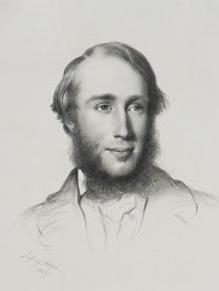
T.C. Baring, 1831-1891.
Michell, a settled conservative, took the bait. Encouraged by new parliamentary arithmetic following the Conservative general election victory in February 1874, loop-holes in the 1871 Act were sought, in Michell's own words, 'to creep through'. Despite some stern opposition, including from William Gladstone, a new bill was drafted explicitly 'to establish the new college free from the restrictions of the Test Act'. Pursuing a policy of deliberate obfuscation, reference to Baring and his plan was omitted from the final bill, which simply recorded an initial unattributed gift of £30,000 for five fellowships, no conditions mentioned. At the last moment, to secure its passage into law, a final clause was added, to Baring's displeasure, brazenly stating: 'Nothing in this Act contained shall be construed to repeal any of the provisions of the Universities Tests Act 1871'. In spirit and intent, if not in letter, nothing was further from the truth.
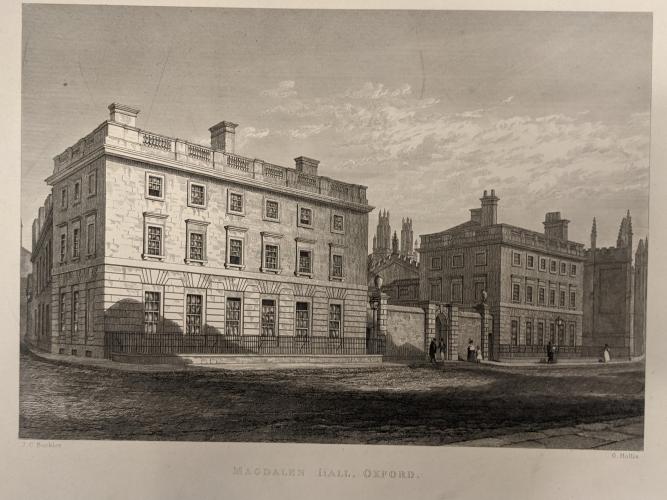
Magdalen Hall, now the site of Hertford College on Catte Street, 1836.
The public subterfuge continued in Hertford's new statutes of 1875 that alluded to the marriage prohibition but not the religious test. To ensure that the college could not, in a fit of reforming ardour, alter his intentions, Baring placed control of his endowments with separate boards of trustees not the college's Governing Body. This bizarre semi-detached arrangement, preventing the college's direct control of its main source of endowment income, persisted to 1970, by which time fellowships were no longer wholly dependent on Baring Trust funds. Baring's total endowment ultimately came to c. £200,000 (perhaps £20-25 million in today's values). The Fellows and scholars receiving money from the Baring trusts all had to declare themselves to be members of the Church of England. The closed nature of the foundation was further emphasised by the rule that Fellows and scholars must be unmarried and the establishment of a series of Closed Scholarships for relatives of Baring and his wife, candidates from Essex, sons of fellows of Hertford and Old Harrovians (as was Baring). Magdalen Hall had been a financially precarious but open institution, admitting the less well-off, the mature and the married. Hertford College was designed as a closed reactionary elite confessional community, scholarly but set in a rich jelly of pre-reform aspic.
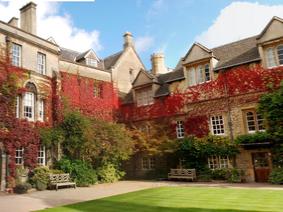
Hertford College, Oxford
This apparent flouting of the 1871 Tests Act did not go unnoticed. The legality of closed confessional Fellowships was challenged in December 1875 through a test case brought by a non-conformist, Alfred Tillyard. He won in the High Court on the grounds that the 1871 Act applied prospectively to new foundations such as Hertford as confirmed in the final clause of the 1874 Act. But, in 1878, he lost in the Appeal Court which conveniently determined that the 1871 Act 'does not of itself prevent (ie, presumably, did not specifically prohibit) the erection in Universities of fresh colleges, of which the endowments may be confined to members of a particular religious community'. The sinuous casuistry behind the drafting of the 1874 Hertford Act and Baring's assault on the 1871 Tests Act thus received the imprimatur of the law.
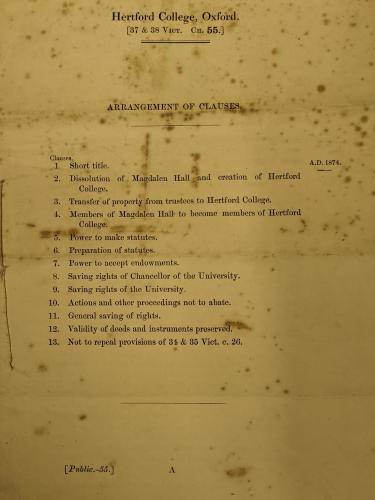
Front page of the Hertford College Act 1874
Even though commoner undergraduates were not subject to the continued religious tests, and chapel attendance appears always to have been voluntary and sketchy, the college soon chaffed at these arrangements that impeded recruitment and retention of career academics. Yet even in the 1920s, it was formal celibacy not faith that was seen as the main problem. No declaring non-Anglicans were elected as Fellows until the 1930s. Baring scholars who left or had never joined the Church of England were still forced to relinquish their awards after the Second World War. As the Baring trustees tended towards conservatism in law and investment, the endowment and college ossified until the 1960s when new opportunities to alter and break the trusts appeared alongside fresh sources of funding for Fellowships. The consequent lifting of dependence on the Baring trusts provided a context for Hertford's transformation into a college of expansive innovation especially in access, a long-delayed expiation for the original rejection of the openness decreed by the 1871 Act. Institutions like Hertford that undergo genuine change and reinvention need not whitewash what went before.
C.J. Tyerman, Professor of the History of the Crusades, Tutorial Fellow and Fellow Archivist, Hertford College.