


Lady Margaret Hall: Women at Oxford and 1871
Lady Margaret Hall and Somerville Hall both received the first small cohort of women students at Oxford in October 1879. Although these new opportunities for women's higher education were controversial, they were not surprising. Girton was founded in Cambridge a decade earlier, followed by Newnham in 1871. Secondary education for girls was expanding rapidly. It was time for action, and a substantial number of senior figures in Oxford University decided to go ahead, independently of the University, to open a place of higher study for women in Oxford.
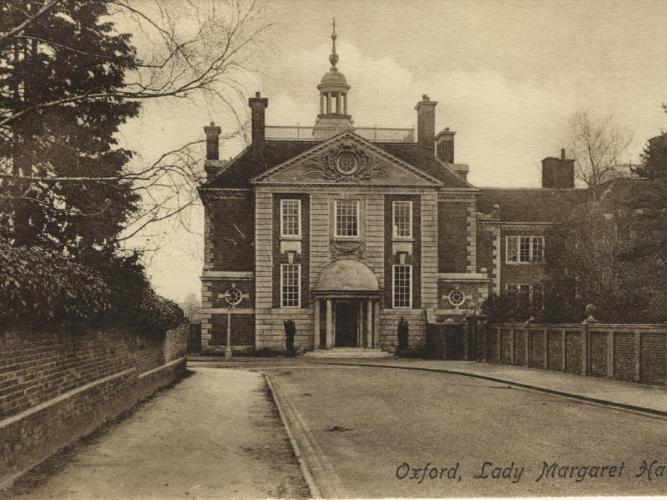
Talbot Hall, c.1911.
Allies on the issues of education and gender, however, split apart on the question of religion. On 4 June 1878 a meeting at Keble College, chaired by its first Warden Edward Talbot, made a crucial decision: 'that it is desirable to attempt the Establishment in Oxford of a small Hall or Hostel in connection with the Church of England for the reception of women desirous of availing themselves of the special advantages which Oxford offers for higher education'. Talbot (later bishop of Rochester then Winchester) and his wife Lavinia were part of a group of high-church Anglicans, for whom the new foundation was at least as much a religious as an educational commitment. For them, the Church of England identity of the new centre was non-negotiable. For many of their friends and co-reformers who wished to see a non-denominational foundation, this religious affiliation was simply unacceptable. Two different committees were set up, leading to the establishment of two different Halls.
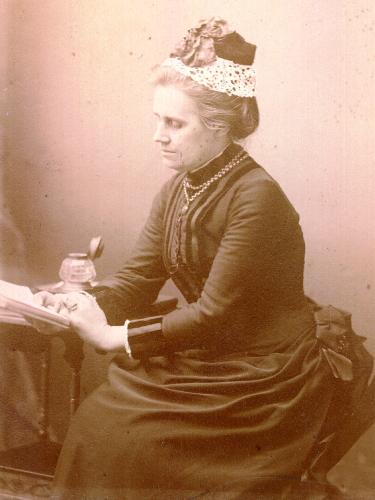
Elizabeth Wordsworth, Founding Principal of Lady Margaret Hall, 1889.
The Anglican group chose as the first Principal of their Hall, Elizabeth Wordsworth, daughter of a bishop and sister of a future bishop. She in turn proposed that it should be named after Lady Margaret Beaufort, mother of Henry VII, a patron of learning whom she described as 'a scholar and a saint'. There remained one question to resolve. Would the new foundation be exclusive to members of the Church of England? Edward Talbot thought it should be, as was the case in Keble. Elizabeth Wordsworth agreed. But the Anglican committee decided on 23 October 1878 that while their Hall would follow 'the distinct principles of the Church of England', others would not be disqualified from membership. This significant decision was soon expressed more positively, guaranteeing provision for the liberty of those not members of that Church.
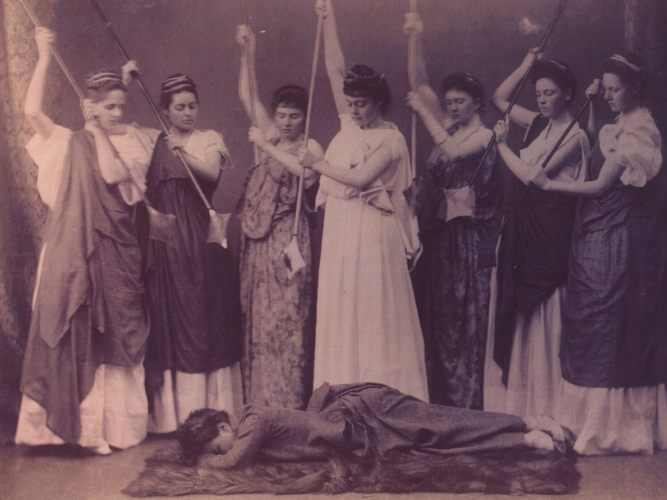
Gertrude Bell play, 1887.
This dual commitment, to the principles of the Church of England, and to religious liberty, has prevailed at Lady Margaret Hall ever since. It was affirmed in the Royal Charter of 1926, and most recently re-affirmed in the Supplemental Charter of 2012. When in the 1960s it became obvious that the requirement in the College Statutes that the Principal should be a member of the Church of England was too restrictive, it was removed. However, the revised Statutes stipulated that if the Principal were not an Anglican, then Lady Margaret Hall must appoint a chaplain from the clergy of the Church of England. In today's very diverse Lady Margaret Hall, the Church of England identity so essential to its founders is not always apparent, but the accompanying tradition from the earliest days of tolerance and respect is very evident, and very powerful.
Dame Frances Lannon, Principal of Lady Margaret Hall 2002-2015.

Follow us on Twitter here.